


Surfacing Options
Why is Safety Surfacing Important?
Playgrounds are fun places where children learn and grow physically and mentally. Inherent in all the climbing and sliding fun remains the fact that playgrounds can also be hazardous places where children can accidentally fall and get hurt. The use of resilient, impact attenuating safety surfacing, therefore, simply seeks to decrease the chances that a child might become seriously injured from a fall in a commercial play setting. It’s important to remember that a child may only use two or three different pieces of play equipment, but every child who walks onto the playground interacts with the surface.
It is fairly evident that a fall onto an impact-absorbing surface is less likely to cause a serious injury than a fall onto a hard surface. Because head impact injuries from a fall are potentially life threatening, the more shock absorbing a surface can be made, the more likely that the severity of the injury will be reduced. However, it should be understood that all injuries due to falls on the playground cannot be prevented regardless of what type of playground surfacing material is used.
Paved surfaces such as asphalt, concrete, gravel or sod are not acceptable for use under playground equipment, or anywhere within the play space. Commercial play equipment such as UPlay Today™ structures cannot be installed over hard, non-resilient surfaces such as these without the use of a safety surface. It is the playground owner’s responsibility to ensure that the area immediately underneath and around any and all play equipment contains an appropriate amount of resilient material to cushion accidental falls.
Types of Surfacing Unitary Materials
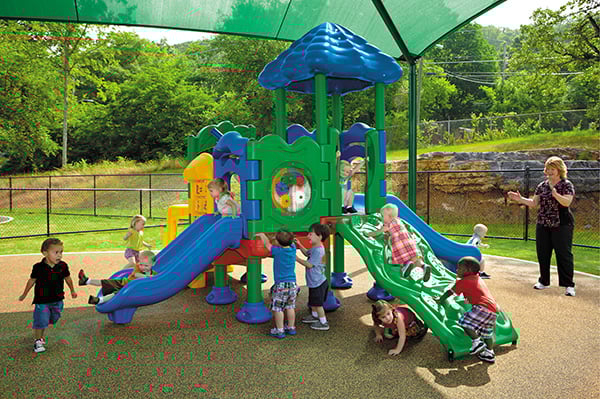
Unitary materials are those that are typically installed as a permanent solution and feature a smooth and seamless surface. This type of surfacing includes Rubber Tiles, Poured-in-Place Rubber, Bonded Rubber and some new generation, synthetic turf products.
These materials typically require installation by trained surfacing professionals and can be quite expensive, in some cases costing as much or more than the actual equipment. A well maintained unitary surface is easy to walk on or roll over and is often the best choice for an accessible playground.
Types of Surfacing Loose-Fill Surfacing
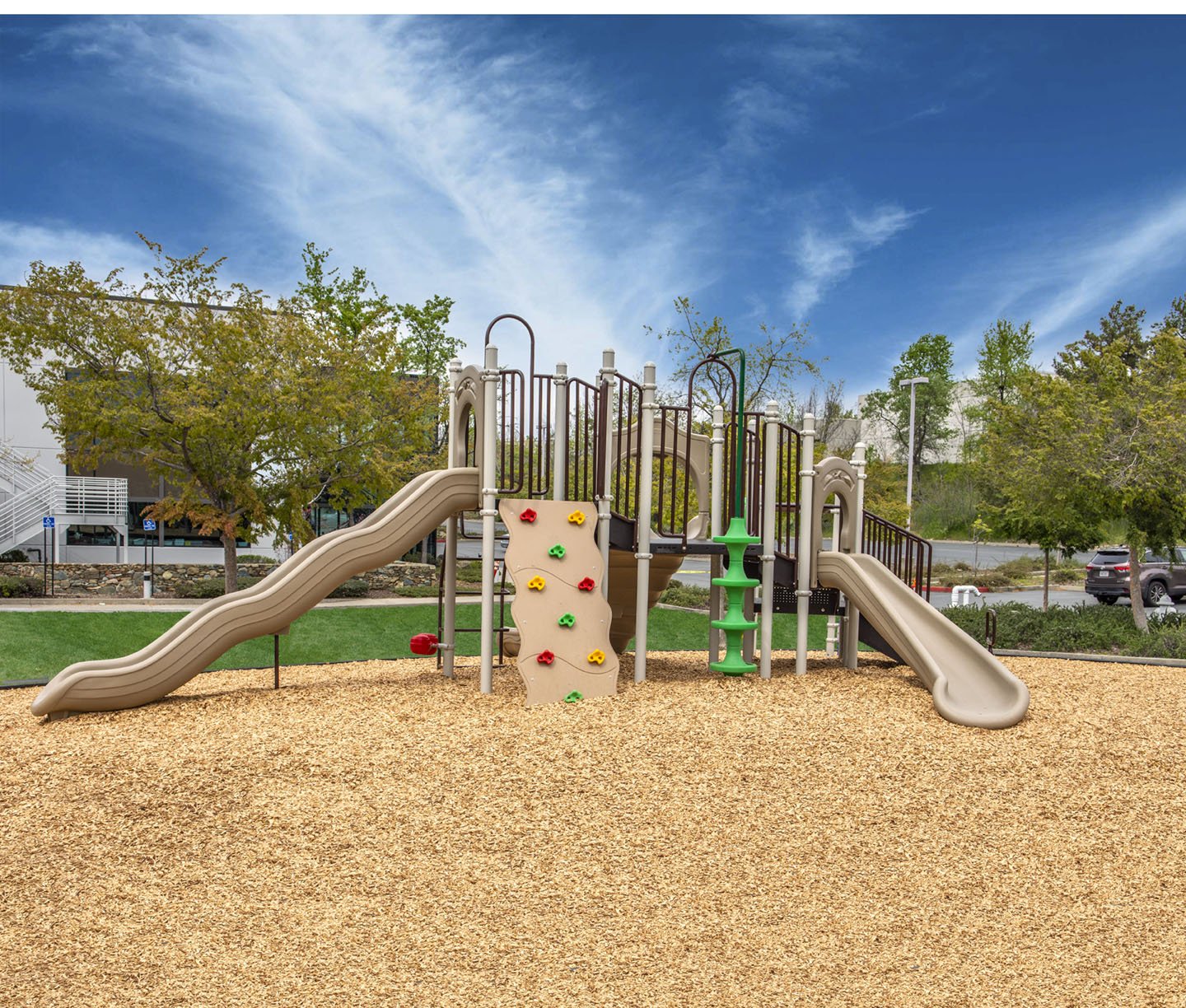
Loose-Fill surfacing, as its name implies, refers to small, loose piece or finely ground materials that are typically purchased in bulk. These materials include Engineered Wood Fiber and Shredded/Recycled Rubber.
These materials are spread within the play space either by a small loader or by hand. Loose-fill surfacing is cost-effective and its relative ease of handling make it the perfect choice for playgrounds where the budget is a concern and volunteers will be doing much of the installation. Loose-fill surfacing is typically kept in place by the use of playground border timbers placed around the perimeter of the play space. These borders are relatively low in cost, maintenance free, long lasting and, most importantly, keep the loose fill materials from washing away. Loose-fill surfacing does require the periodic “topping off” over its lifetime due to natural settling. There are two categories of protective surfacing: Unitary and Loose-fill.
Our Recommendations Most Effective Surfacing Options for UltraPlay Systems
Three types of safety surfacing are recommended for use with UPlay Today™ equipment and work most effectively with the system’s adjustable footer system.
Engineered Wood Fiber
- Manufactured from engineered, non-toxic, crushed wood fiber
- Is a good solution for playgrounds erected on dirt or grass
- Once settled, forms a "knitted" or compacted layer that will support a wheelchair, crutches, walkers, etc.
- It does not utilize any wood containing paint, chemicals or additives
- Has minimal bark and is free of twigs, leaf debris and other organic materials
- The most economical surfacing choice, but will require more maintenance and occasional topping off to maintain the recommended depth, and remain compliant with standards and warranty
- Easily installed by volunteer labor, as well as by an installer
- When placing your order inquiry with us, we can provide a custom quote of this material for you
Rubber Tiles
- Low maintenance
- Allows for individual tile replacement
- Superior shock absorption characteristics
- Provide a guaranteed critical fall height value
- Is a good solution for playgrounds erected on a smooth surface such as concrete or asphalt with no elevation changes
- Long wear and meets ADA accessibility requirements
- Features a high-quality granular formulation offering a resilient base for years of play and enjoyment
- Professional installation is recommended
- Green recycled rubber material
- Beveled edges, corners and glue also available
- See this product in our Product Gallery
Pour in Place
- Attractive, resilient, seamless two-layer surface that is slip-resistant and ultimately accessible
- Available in a variety of colors that can be can be combined to create inlaid designs and graphics
- Thicknesses are specified to meet critical fall heights found within the playground
- Is a good solution for playgrounds erected on a smooth surface such as concrete or asphalt
- Installation must be performed by technically trained, approved specialists
- Involves a higher initial investment, but requires less maintenance over the life of the product
- Porous to allow free flow of water
- When placing your order inquiry with us, we can provide a custom quote of this material for you
Depth of Surfacing
The highest play surface or piece of playground equipment where a child can stand determines the equipment’s critical fall height. The safety surfacing must meet minimum performance requirements for its effectiveness in the cushioning of impacts based on this critical fall height. This is known as impact attenuation. Differing depths or thicknesses of safety surfacing must meet the impact attenuation requirements based on the equipment used.
Loose fill surfacing depth must provide the necessary impact attenuation specified by the equipment’s critical fall height. Surfaces must be checked at least weekly for compacting, which will significantly reduce the material’s resiliency and shock absorbing characteristics. Worn surfaces around equipment should be restored and concrete footings should never be exposed. Check for erosion and cratering of surfaces under swings, slides, and heavy traffic areas and restore surfacing as necessary. Annual “topping off” of loose fill surfacing should be a regular part of any playground maintenance schedule. It is a good idea to mark the upright posts with the ideal height required for loose fill material as a quick visual reference.
Rubber tiles and poured-in-place rubber must also meet varying thickness requirements to provide the necessary impact attenuation specified by the equipment’s critical fall height. This required thickness is manufactured into rubber tiles and specified at the time of purchase based on the equipment’s highest designated play surface. UPlay Today™ rubber tiles feature a 2 ½” thickness which provides the required impact attenuation from a 6 foot height, the highest play surface found on this equipment. Poured-in-Place rubber used with UPlay Today™ playsystems would also be required to be at least 2 ½” thick.
Need Support Planning Your Ultimate Play Space?
Contact us to be connected with a Playground Specialist who can help every step of the way.